 Toolpath
• 54 min
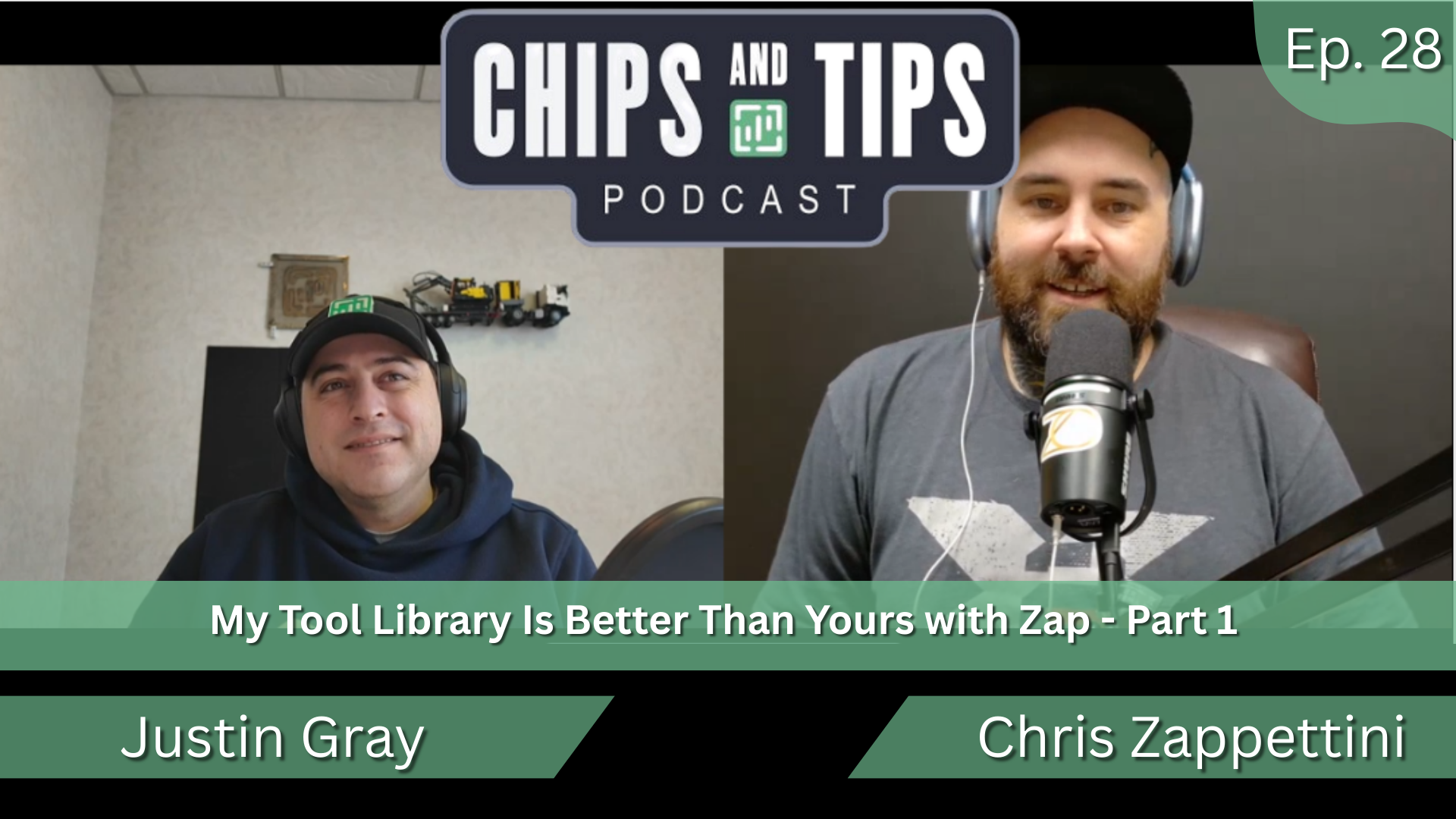
My Tool Library Is Better Than Yours with Zap - Part 2
Chips and Tips Podcast
Play


If your shop is stuck debating tool numbers, you are missing the bigger opportunity. In this episode of Chips and Tips, Justin and Zap break down the real purpose of a tool library: getting parts on the machine and out the door faster. From four-digit Tool ID systems to stick-out discipline, they challenge the “every job is special” mindset and show how a standardized approach unlocks speed, consistency, and profitability.
The tool ID system: Separating identity from position
This episode picks up in the middle of a deep dive on tool libraries, and it gets practical fast. Zap walks through how he thinks about a four-digit Tool ID, or TID, as the identity of a rotating assembly. Not just the cutter, but the holder, the collet, the extension, and the stick-out. That combination, documented and repeatable, is what earns a unique ID.
Justin draws a critical distinction: a TID is not the same as a tool number. Tool numbers can change from program to program. A facing tool might be Tool 1 in one job and Tool 6 in another. But if it is always TID 0073, you can track it, trust it, and reuse it across CAM systems. That separation gives you flexibility without chaos.
The conversation makes one thing clear. The TID system sidesteps endless debates about “perfect” tool numbering schemes. Assign a sequential ID. Do not overthink it. Do not reuse numbers. And do not be afraid to delete a tool from your library if it no longer makes sense. This is about clarity and control, not perfection.
Standardization is not optional if you want throughput
A major theme in this episode is resistance. “My shop is different.” “Every job is unique.” “I cannot standardize.” Justin and Zap push back hard on that mindset. The goal is throughput. How fast can you get a part on the machine, make a good first piece, and ship it?
Without a consistent tool library, you are guessing. Different holders. Different stick-outs. Different cutting behavior. That guesswork slows down first-part yield and kills setup efficiency. With a documented tool library, modeled holders, and defined cutting data, you reduce variables. When something goes wrong, you know it is the material or the part, not your tooling chaos.
The message is direct: if you believe you cannot standardize, you are choosing to trade your time for perceived savings. You are also capping your shop’s scalability. A business built on “I just know how to build it” cannot grow beyond the person who knows.
How to start if you have nothing
For shops with no tool library, the advice is refreshingly simple. Start with the next program. Measure the tools in the machine. Confirm the geometry. Assign TIDs. Document stick-out. Save it correctly in your CAM system. Do not try to rebuild your entire history overnight.
If legacy jobs are running well, keep them running. But from this point forward, use the new system. When an old job comes back, audit it and convert it. This incremental approach avoids overwhelm and builds discipline over time.
The key habit is auditing. If a half-inch stick-out works just as well as three-quarters of an inch, eliminate the unnecessary variation. If you discover a better configuration, create a new TID and move forward. Your tool library should evolve as your shop learns.
Optimize after it runs
One of the strongest ideas in the episode is this: optimization comes after stability. A program does not need to be perfect to be valuable. If you can generate a reliable program, load it, hit cycle start, and get a good part, you have already won.
Chasing marginal cycle time improvements before you can trust your setup is backwards. A two-minute savings on a five-minute cycle does not matter if it took you an extra day to get to first chip. Good parts, fast parts. That is the priority.
A disciplined tool library is the foundation for that reliability. It reduces guesswork, increases confidence in simulation, and shortens time to first part. From there, you can optimize strategically, not desperately.
Three viral quotes from the episode
- [00:21:17] Zap: “The best way is, just do it.”
Context: Zap pushes back on overthinking tool library strategy and encourages shops to start building discipline immediately. - [00:43:38] Justin: “If you sit there and say, I cannot develop a standardized system, then I would argue that you're doing it wrong.”
Context: Justin challenges the idea that standardization is impossible in custom or prototype environments. - [00:51:22] Zap: “The optimization should be happening after it's running.”
Context: Zap reframes the order of priorities, arguing that stable throughput beats theoretical cycle time gains every time.
From estimate to machining, smarter and faster with Toolpath. When your tool library reflects the real assemblies on your floor, your CAM, your quoting, and your production all speak the same language. That is how you close the productivity gap.
Watch My Tool Library Is Better Than Yours with Zap - Part 2